The Otterville Subdivision has as its origin the Port Dover & Lake Huron Railway (P.D. & L.H.Ry.), which opened as follows:
It is unclear, however, when regular traffic started as the Government inspection was not completed until 1875-11-02. By 1875-11-11 two weekly trains operated between Port Dover and Woodstock on Wednesdays and Friday. A 1875-12-11 newspaper article announcing completion of ballasting from Port Dover to Woodstock stated that in a short time regular traffic will commence
. During the 1876-02-03 opening ceremony in Stratford it was unclear if the road was opened for regular service. The P.D. & L.H.Ry. was operating two trains, each way, daily between Port Dover and Stratford and a steamer between Port Dover and Erie, Pennsylvania by June 1876.
After 1881-03-04 merger of the P.D. & L.H.Ry., Stratford & Huron Railway and Georgian Bay & Wellington Railway into the Georgian Bay & Lake Erie Railway—a wholly owned subsidiary of the Grand Trunk Railway (G.T.Ry.)—the P.D. & L.H.Ry. track paralleling the G.T.Ry. between Tavistock Jct. and Stratford was abandoned.
In the G.T.Ry. era, Port Dover to Tavistock Jct. was part of the 21st District.
In the early Canadian National Railways (C.N.Rys.) era, the Otterville Subdivision extended from Port Dover to Tavistock Jct., encompassing the ca. 1954 Hickson and Simcoe Subdivisions. The original Otterville subdivision was abandoned as follows:
- Simcoe Jct. to Otterville: 1935-08-19;
- Hickson to Tavistock Jct.: 1935-09-18; and
- Burgessville to Woodstock: 1935-12-04.
After the abandonment, there was bus service between Tillsonburg (until ca. 1943), Otterville (until ca. 1943), Norwich, Burgessville and Woodstock.
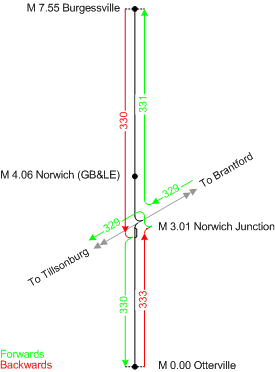
As early as 1930, the Brantford/Tillsonburg mixed train (330/331 later 328/329) provided twice daily (except Sundays and holidays) service between Otterville, Norwich Jct., Norwich and Burgessville, when service dropped to once daily (the "noon" train 329).
Train 329, operating as train 331, would run forwards to Norwich and Burgessville then as train 330 would run backwards to Norwich Jct., back onto the Burford Subdivision clear of the junction switches, normal the Norwich switch and reverse the Otterville switch, then run forwards to Otterville. From Otterville, train 333 would run backwards to Norwich Jct., back onto the Burford Subdivision, normal the Otterville junction switch then proceed to Tillsonburg.
 |
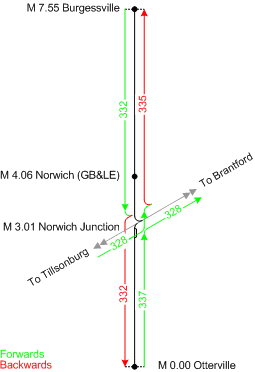 |
| Mixed train service on the Otterville Subdivision ca. 1934. | |
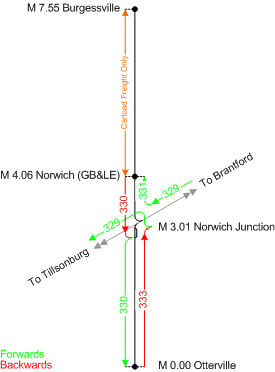
Mixed service to Burgessville continued through the summer of 1941, then for carload freight only. Mixed service disappeared completely when the Brantford/Tillsonburg mixed train 328/329 was discontinued by time table effective 1954-04-25.
 |
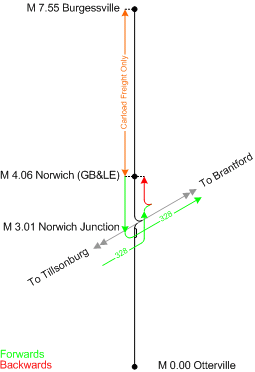 |
| Mixed train service on the Otterville Subdivision ca. 1944. | |
The Otterville Subdivision from Otterville to Norwich Jct. and from Norwich to Burgessville was authorized for abandonment on 1963-07-26 and was removed from time tables effective 1963-10-27. The remaining track became the Burford Subdivision/Norwich Spur by 1965-04-25. This last remnant of the Otterville Subdivision survived until 1987-11-25, when the C.N.Rys. abandoned most of the Burford Subdivsion.
Special Instruction No. 19 applicable.
No regular trains on this Subdivision. Service as required.
*Yard limits extend from end of track Otterville to end of track Burgessville.
Speed restrictions Miles per hour All trains 15
Permanent slow orders Mileage Miles per hour 4.08 Norwich—Main Street (first North of Station) 10 For further speed restrictions, see page 28.
Engine and car restrictions Heaviest auxiliary crane permitted 100 ton.
Other tracks Car Capacity Points Face Mileage Deller Bros. 2 N 5.44
Train order offices Station Hours of Service Days of Service Norwich 8.30 a.m. to 5.30 p.m. Mon. to Fri. incl. Otterville 8.00 a.m. to 5.00 p.m. Mon. to Fri. incl.
Emergency telephones Mileage 22.03 Second pole, west of junction switch, Burford Subdivision.
| Date | Event |
|---|---|
| 1848-04-15 | W. & L.E.Ry. is incorporated with authority to build a railway between Woodstock and the harbours of Port Dover and Port BurwellStevens-1960, p. 462. |
| 1859-02 | W. & L.E.Ry. merges with the A. & St.T.Ry. to form the G.SW.Ry.Stevens-1960, p. 463. |
| 1859-08 | G.SW.Ry. becomes the N. & D.R.Ry.Stevens-1960, p. 463. |
| 1871-01-19 | Stratford and Woodstock delegations meet in Woodstock to discuss a railway between their citiesThe Woodstock Sentinel, Friday, January 20, 1871 , p. 3. |
| 1871-11-24 | Application will be made to revive the W. & L.E.Ry. charterThe Woodstock Sentinel Friday, December 1, 1871, p. 3. |
| 1872-03-02 | P.D. & L.H.Ry. takes over the assets of the N. & D.R.Ry.Stevens-1960, p. 464. |
| 1873-02-03 | Railway meeting at Norwich passes resolution for a $20,000 bonus to the P.D. & L.H.Ry.The Woodstock Sentinel, Friday, February 7, 1873, p. 2. |
| 1873-02-10 | Surveying between Woodstock and Stratford commencesThe Woodstock Sentinel, Friday, February 14, 1873, p. 3. |
| 1873-04-08 | East Oxford votes on by-law to grant $10,000 bonus to P.D. & L.H.Ry.The Woodstock Sentinel, Friday, April 4, 1874, p. 2. |
| 1873-10-09 | P.D. & L.H.Ry. tenders for grading, bridging, fencing and furnishing of ties ... between Port Dover and WoodstockThe Woodstock Sentinel, Friday, October 10, 1873, p. 3. |
| 1873-11-13 | Contract for grading, bridging, fencing and furnishing of ties ... between Port Dover and Woodstocklet to Joseph WhiteheadThe Woodstock Sentinel Friday, November 14, 1873, p. 2. |
| 1874-01-04 | P.D. & L.H.Ry. announces intention to apply to the Ontario Legislature to:
|
| 1874-01-16 | Ties for the P.D. & L.H.Ry. are being laid in South Norwich. Contract for Otterville bridge awarded to George KentThe Woodstock Weekly Review, Friday, January 16, 1874 , p. 1. |
| 1874-04-04 | First call on subscribed stockThe Norfolk Reformer (Simcoe), Thursday, April 9, 1874, p. 3. |
| 1874-06-29 | Grading near Otterville is nearly complete and fencing work has commencedThe Daily Globe (Toronto), Monday, June 29, 1874 , p. 2. |
| 1875-03-05 | Rails for Port Dover to Simcoe section of P.D. & L.H.Ry. are delivered to SimcoeThe Woodstock Weekly Review, Friday, March 5, 1875 , p. 8. |
| 1875-03-08 | About seventy car loads of iron is delivered to Simcoe with balance to be shipped via Port Dover upon opening of navigationThe Daily Globe (Toronto), Monday, March 8, 1875, p. 1 |
| 1875-03-17 | It is reported that the P.D. & L.H.Ry. is expected to open in six weeksThe Daily Globe (Toronto), Wednesday, March 17, 1875, p. 2. |
| 1875-08-18 | Track laying on the P.D. & L.H.Ry. reaches OttervilleThe Daily Globe (Toronto), Thursday, August 19, 1875 , p. 1. |
| 1875-08-24 | P.D. & L.H.Ry. operates excursion train from Norwich to Port Dover, round-trip fare 75¢The Woodstock Weekly Review, Friday, August 20, 1875, p. 5; Friday, September 3, 1875, p. 4 |
| 1875-08-26 | P.D. & L.H.Ry. opens to NorwichThe Daily Globe (Toronto), Thursday, August 28, 1875, p. 8 |
| 1875-09-07 | Track laying on the P.D. & L.H.Ry. completed to within a few miles of WoodstockThe Daily Globe (Toronto), Wednesday, September 8, 1875, p. 1. |
| 1875-10-05 | P.D. & L.H.Ry. operates excursion train from Port Dover and intermediate stations to WoodstockThe Norfolk Reformer (Simcoe), Thursday, October 14, 1875, p. 2. |
| 1875-10-06 | P.D. & L.H.Ry. opens to WoodstockThe Daily Globe (Toronto), Thursday, October 7, 1875, p. 1; Hopper-1962, p. 324. |
| 1875-10-14 | P.D. & L.H.Ry. announces station agent and conductor appointmentsThe Norfolk Reformer (Simcoe), Thursday, October 14, 1875, p. 2. |
| 1875-11-02 | Government Engineer Mr. Molesworth makes inspection of P.D. & L.H.Ry.The Daily Globe (Toronto), Wednesday, November 3, 1875, p. 3. |
| 1875-11-11 | P.D. & L.H.Ry. operates two trains weekly (Wednesdays and Fridays) between Port Dover and WoodstockThe Norfolk Reformer (Simcoe), Thursday, November 11, 1875, p. 2. |
| 1875-12-11 | P.D. & L.H.Ry. completes ballasting from Port Dover to WoodstockThe Daily Globe (Toronto), Saturday, December 11, 1875, p. 2. |
| 1876-02-03 | P.D. & L.H.Ry. opens to StratfordThe Daily Globe (Toronto), Friday, February 4, 1876, p. 2, c. yHopper and Stevens both give January 1, 1876 as the opening to StratfordHopper-1962, p. 324; Stevens-1960, p. 464.. |
| 1876-06-07 | P.D. & L.H.Ry. runs two passenger trains daily with steamer connection to Erie, PAThe Daily Globe (Toronto), Wednesday, June 7, 1876, p. 1. |
| 1876-10-28 | P.D. & L.H.Ry. publishes notice of application to the legislature to amend its acts of incorporationThe Daily Globe (Toronto), Saturday, October 28, 1876, p. 1. |
| 1877-01-31 | P.D. & L.H.Ry. bill passes through the Railway CommitteeThe Daily Globe (Toronto), Thursday, February 1, 1877 , p. 3. |
| 1881-03-04 | G.B. & W.Ry., P.D. & L.H.Ry. and S. & H.Ry. merge to become the G.T.G.B. & L.E.Ry., a wholly-owned subsidiary of the G.T.Ry.Stevens-1960, p. 467. |
| 1881-03c | Tavistock Jct. to Stratford abandoned, G.T.G.B. & L.E.Ry. operates on B.B. & G.Ry.Bowers-1983, p. 162. |
| 1911-06-04 | 21st District, Port Dover and TavistockGTRS.MD.43. |
| 1920-06-27/1922-10-01 | 21st District, Tavistock Subdivision, Port Dover to Tavistock Jct.GTRS.OL.LSD.2/11. |
| 1923-01-31 | G.T.Ry. becomes part of C.N.Rys.Bowers-1983, p. 162, Cooper-2001, p. 394. |
| 1923-06-24/1935-06-23 | Otterville Subdivision, Port Dover to Tavistock Jct.CNR.CR.SWOD.LSD.2/CNR.CR.SOD.LSD.57. |
| 1930-01-05 | Burford Subdivision mixed trains 330 and 331 operate between Norwich Jct. and Norwich on the Otterville Subdivision by Train OrderCNR.CR.SOD.LSD.33. |
| 1930-04-27 | Burford Subdivision mixed trains 330 and 331 operate between Norwich Jct. and Norwich on the Otterville Subdivision using Electric Staff Block SystemCNR.CR.SOD.LSD.34. |
| 1931-06-28 | No First Class trains on Otterville Subdivision between Simcoe Jct. and Tavistock Jct.. Second Class freight trains 344 and 345 carry passengers. Burford Subdivision mixed trains 328 and 329 operate between Norwich Jct. and NorwichCNR.CR.SOD.LSD.39. |
| 1932-02-18 | S.W. Fairweather requests study of traffic between Woodstock and NorwichNAC RG30 Vol. 10120 File 6340-29 |
| 1934-08-20 | C.N.Rys. reports earnings of $141.18 per mile per annum for Woodstock-Burgessville section of Otterville SubdivisionNAC RG30 Vol. 10120 File 6340.29 Earnings for Otterville Subdivision, Woodstock-Burgessville, Oct. 1930 to Sep. 1931, . |
| 1932-05-01 | Mixed train 345/346/347 operates between Otterville and Hickson. Burford Subdivision mixed trains 328 and 329 operates between Norwich Jct. and Norwich. No service between Simcoe Jct. and OttervilleCNR.B.60, Tables Nos. 195 & 204. |
| 1932-09-25 | No service between Burgessville and WoodstockNAC RGG30 Vol. 10120 File 6340.29 Letter W.A. Kingsland to S.J. Hungerford 1934-06-27. Otterville, Norwich and Burgessville served by Brantford/Tillsonburg mixed trains M329 and M328CNR.CR.SOD.LSD.44. |
| 1932-12-05 | C.N.Rys. ceases train service and maintenance between Hickson and Tavistock Jct.NAC RG54 Vol. 354 File 39310.22 |
| 1933-06 | Norwich Jct. diamond removed and switches at M26.44 and M26.70 "spiked" from Burford SubdivisionBrian West—correspondence]. |
| 1933-11c | C.N.Rys. ceases train service and maintenance between Simcoe Jct. and OttervilleB.R.C. File No. 39310.19. |
| 1934-08-02 | In the revised list of C.N.R. Branch Lines proposed for abandonment, the line between Fort Erie and Brantford has been changed to Fort Erie-Canfield Jct. and the line Otterville-Woodstock has been changed to to Burgessville-Woodstock.NAC RG30 Vol. 10120 File 6340-29 |
| 1935-01-12 | C.N.Rys. reports 1934 taxes of $938 for Burgessville to Woodstock:
|
| 1935-01-18 | C.N.Rys. applies to abandon Otterville Subdivision between:
|
| 1935-03-11/1935-03-13 | In connection with the abandonment applications, D.G. Kilburn (Division Engineer, B.R.C.), J.L. Bourgault (Inspector of Operations, B.R.C) and C.N.Rys. officials inspect Otterville Subdivision between Simcoe Jct. and Otterville, and Burgessville and Woodstock and meet with representatives from Simcoe, Otterville, Norwich, Burgessville and WoodstockNAC RG46 Vol. 393 File 39310.12 and RG46A Vol. 507 File 39310.19; The Daily Sentinel Review (Woodstock), March 12, 1935, p. X; March 13, 1935, p. X; & March 14, 1935, pp. 1 & 4. |
| 1935-03-18 | J.L. Bourgault and D.G. Kilburn recommend granting C.N.Rys. application to abandon Otterville Subdivision between Simcoe Jct. and OttervilleInspection Report, NAC RG46A Vol 493 File 39310.12 and between Burgessville and WoodstockB.R.C. File No. 39310.19 Inspection Report. |
| 1935-05-08 | B.R.C. holds meeting in Simcoe regarding C.N.Rys. application to abandon Otterville Subdivision between Simcoe Jct. and OttervilleB.R.C. File No. 39310.19. |
| 1935-05-10 | B.R.C. holds meeting in Woodstock regarding C.N.Rys. application to abandon Otterville Subdivision between Burgessville and WoodstockB.R.C. File No. 39310.12. |
| 1935-08-15 | B.R.C. issues judgment re C.N.Rys. application to abandon Otterville Subdivision between Simcoe Jct. and OttervilleB.R.C. File No. 39310.19 Judgment. |
| 1935-08-19 | C.N.Rys. authorized to abandon Simcoe Jct. to Otterville (refer to Simcoe Subdivision for subsequent history of Port Dover to Simcoe Jct.)B.R.C. Order 52185 |
| 1935-09-10 | B.R.C. issues judgment re application to abandon Otterville Subdivision between Woodstock and Tavistock Jct.B.R.C. File No. 39310.22 Judgment. |
| 1935-09-16 | B.R.C. issues dissenting opinion re C.N.Rys. application to abandon Otterville Subdivision between Woodstock and Tavistock Jct.B.R.C. File No. 39310.22 Dissenting Opinion. |
| 1935-09-18 | C.N.Rys. authorized to abandon Hickson to Tavistock Jct.B.R.C. Order 52254 |
| 1935-11-23 | B.R.C. issues judgement re C.N.Rys. application to abandon Otterville Subdivision from Burgessville to WoodstockB.R.C File No. 39310.12 Judgment. |
| 1935-12-02 | B.R.C. issues dissenting opinion re C.N.Rys. application to abandon Otterville Subdivision between Burgessville and WoodstockB.R.C File No. 39310.12 Dissenting Opinion |
| 1935-12-04 | C.N.Rys. authorized to abandon Otterville Subdivision ... between Burgessville, Mile 31.0, and Woodstock, Mile 40.2, a distance of 9.2 milesB.R.C. Order. 52519, refer to Hickson Subdivision for subsequent history of Woodstock to HicksonHopper gives the date of abandonment as December 4, 1936Hopper-1962, p. 324. A letter from Charles Austin (my grandfather) of Burgessville to the Railway Commissioner dated 1936-04-11 would seem to imply that the rails were not lifted until sometime during 1936B.R.C. File No. 39310.12. When the line was dismantled, only the bridges, rails, fishplates, spikes and tie plates were removed. Ties, 90% of which were untreatedB.R.C. File No. 39310.12 so probably of no value to the railway, ballast and fencing were removed by the farmers. A 1945-09-04 aerial photographN.A.P.L. A9208-022 shows the right-of-way essentially undisturbed nearly a decade after the abandonment.. |
| 1936 | Switches at M26.44 and M26.70 removedBrian West—correspondence]. |
| 1936-10-02 | M18.40 to M18.43 including ?? removed under 1934-05-01 agreement with M.C.Rd.Brian West—correspondence. |
| 1936-04-26/1938-04-24 | Hickson Branch, Woodstock to Hickson; Otterville Branch, Norwich Jct. to Otterville; and Burgessville Branch, Norwich Jct. to BurgessvilleCNR.CR.SOD.LSD.59/65. |
| 1938-09-25/1963-06-23 | Otterville Subdivision, Otterville to BurgessvilleCNR.CR.SOD.LSD.66/CNR.GLR.LA.29. |
| 1941-06-22 | Otterville, Norwich and Burgessville served by Brantford/Tillsonburg mixed train M329/M328CNR.B.107, Table No. 195. |
| 1941-11-02/1953-11-29 | Otterville (once daily by M329) and Norwich (twice daily by M329/M328) served by Brantford/Tillsonburg mixed train M329/M328CNR.B.109/160, Table No. 195. |
| 1954-04-25 | Train M328/M329 discontinuedCNR.B.161. |
| 1963-07-26 | C.N.Rys. authorized to abandon Otterville Subdivision from Otterville to Norwich Jct. and from Norwich to BurgessvileB.T.C. 111791. |
| 1963-10-27/1964-10-25 | Otterville Subdivision, Norwich Jct. to NorwichCNR.GLR.LA.30/32. |
| 1965-04-25/1987-11-29 | Burford Subdivision/Norwich SpurCNR.GLR.LA.33/CNR.GLR.NOSOD.57. |
| 1987-11-25 | C.N.Rys. authorized to abandon Norwich SpurRTC Order No. R-41264 |
| 1988-05-01 | Removed from time tableCNR.GLR.NOSOD.58. |